
Featured Knowledge Transfer Series Post
KTS Post #92 – Surfin’ the Tsunami with a Margin Clerk
February 15th, 2026
It’s Sunday! Cold outside and warm inside. The coffee is ready and so are we! No more restrictions on length – so we sit down to an absolute feast of the beast! Note, this one will be particularly long as we will try and bring some context in that we believe is pertinent. So make sure you got the TIME to read it in one sitting with multiple cups of java! Just keep in mind that this first KTS post within the Beskar Capital KTS platform is around 20x longer than what to typically expect!!!
Before we get started, I want to plant this note that this marks the first post since transferring the real-TIME KTS series post over to the membership platform. From now on, these posts come weekly. And good thing too…..because they need to. Getting back to what we do best! So let’s go!
So far, 2026 has been exactly what we thought it would be. Volatility on steroids. As we have been watching for awhile now, angst in select tech stocks has everyone sitting up – afterall, that Mag7 trend has been a catalyst since 2016 to current – outperforming the S&P500 by a score of 875% to 287% over that period of TIME! What a win!!!
But what’s happened since mid 2025? The cracks. At the peak, they made up ~35% of the index. Currently, we stand around 34%. Is this the inflection point we expect within the context of the real estate/banking crisis cycle? Most of us can feel it ourselves. Ask yourself, do you feel just as strong about throwing new cash into Mag7 stocks as you did a year ago? Or are you a little bit more cautious now?
Of course you are more cautious.
The concerns are everywhere. And you know them. The circular capital funding schemes amongst themselves:

Meanwhile, the analysts and the talking heads proclaim we are in “the early innings” of the AI revolution – stay the course! And that’s no doubt true…..the part about the early innings of the AI revolution. That’s not even debatable.
BUT…..that doesn’t mean that we can’t have a steep market drop in the middle of the 2nd inning that can last a lllllooonnnnggg TIME. A prolonged rain delay….. to keep the analogy alive!
Here’s some things to consider. In the run up in the late 1990’s for the internet boom, the parallels are uncanny. The leaders out of the gate were dominant. The premier ISP (internet service provider) was America Online. We all had it. You’ve heard that old fuzzy, minute-long beeping of the modem connecting to the email inbox, “You’ve got Mail!” You just sat there with your fingers crossed hoping it would connect. It was like finding out that you got into heaven when it actually did!
And then there was search. For those old enough, do you remember all of them!?!?? Excite, Altavista, Webcrawler, Infoseek, Ask Jeeves, Yahoo, Lycos, Veronica, Archie.
And out of these who was the winner??? Google!
Then the optical fiber. The “Infrastructure” companies of the revolution! You know….the thinly drawn glass “wire” for lasers to carry the data as fast as possible? Think Corning and Ciena. And the optical fiber component company JDS Uniphase. In the final stages of the run up …… these stocks went from parabolic to rocket launch! As a young investor then, I made so much money on JDSU and SEEK. Oh my. Really……. Oh my.
And those (crazy) days are back. Corning (GLW), Ciena (CIEN), and JDS Uniphase (old JDSU but now merged into Lumentum Holdings (LITE). Don’t believe me?
Here’s the comparative charts from then …… and today for each:
Corning (GLW)
June 1998 to August 2000:

June 2023 to February 2026:

Look familiar?
How about looking at all of the TIME between these two periods, including these? So let’s pull the June 1998 to February 2026 chart for Corning:

If I printed this chart up and gave it to you with a pen – then granted you four circles to place on this chart of your choosing. Two circles for ideal TIMES to buy. Then two circles for ideal TIMES to sell. What would you do? Where would place them?
Let’s move on to Ciena.
Ciena (CIEN)
June 1998 to October 2000:

And then how about today…
June 2023 to February 2026:
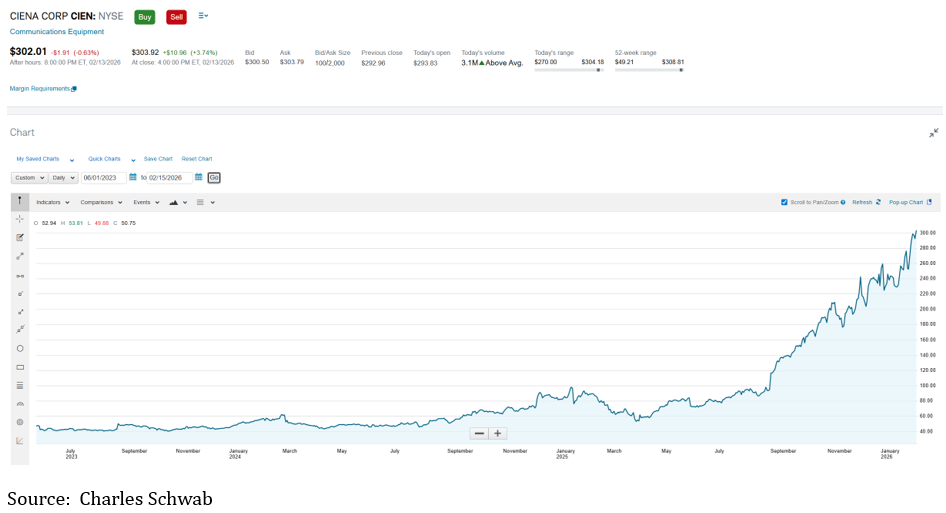
Looking familiar?
And how about the TIME between these two events?
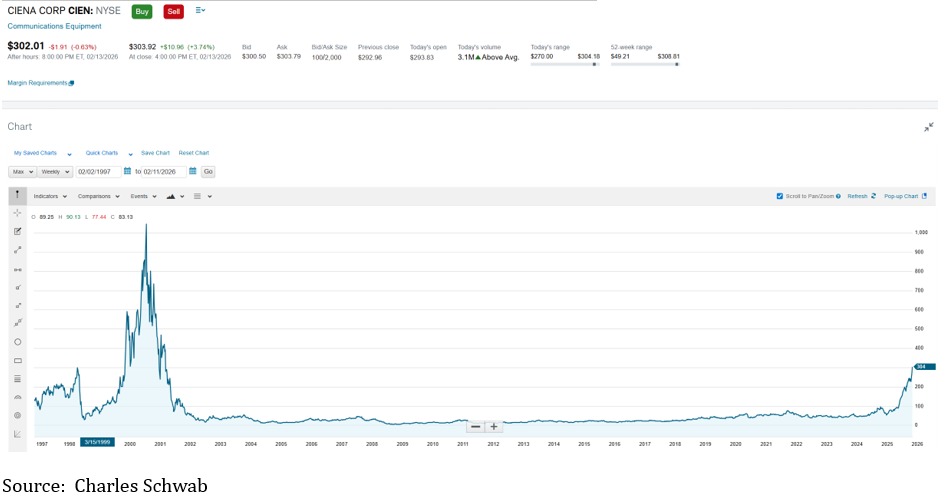
Still got those Genie pens I gave you? Go ahead and print and make your 4 circles!
Continuing to JDS Uniphase.
JDS Uniphase (JDSU / LITE)
June 1998 to October 2000 (Had to go to deep search to find this since it merged with LITE):
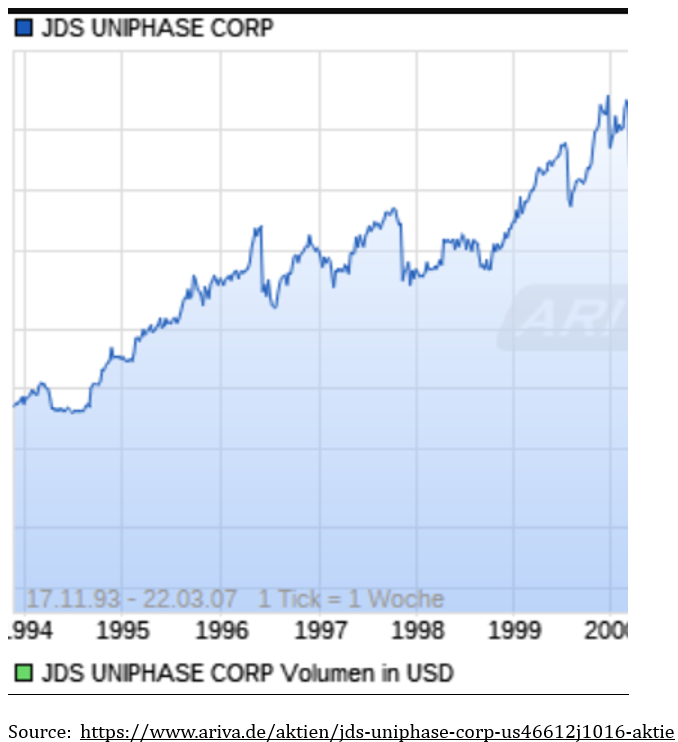
Looks exactly like Corning and Ciena, eh?
And how about the merged company, Lumentum Holdings today?
June 2023 to February 2026:

Ah yes. There it is. Completely recognizable. The meltup.
So what exactly is the point of all of this pattern finding, Beskar????
Great question. To be direct: It’s recognition of a cycle.
At Beskar Capital, we study the ticker tape in the context of cycles. We have realized tremendous success in managing our portfolio over TIME by learning this skill. The most successful economists, traders, and investors have taught us these methods and strategies. And while there’s always some elements of change over TIME, the approaches and their application remain fundamentally similar.
We wanted to kick off this first KTS post within the Beskar community as an overview for what to keep at the forefront as we proceed through 2026. Together we will explore cycles and the responsive ticker tape of select securities within in to build our understanding of how to read markets. So looking forward to this journey with you as a member!
Let’s get back to our analysis.
So what happened after those late 1990’s meltups, Beskar? And what can we glean from it for today?
Well, what developed was a race for survival. Any company that was connected to internet technologies was expanding as fast they could. The idea was like the Homestead Act of 1862, which was a push by the government to encourage westward migration by offering settlers land if they went out and lived on. After 5 years of cultivating it, it was theirs – free and clear from government ownership.
Similarly, the U.S. government is incentivizing the push to own the AI revolution. And as expected, the rush is on to pour massive amounts of capital expenditures from everyone, from everywhere. Wild, Wild, West, indeed!
The companies are happy to oblige – partly for the greed to grow ….. and partly for the fear of being left behind ….. and bankrupt! We are in the middle of it now. Ride free (and fast) or Die!
Correspondingly, the stock markets that you are witnessing and participating in are going bonkers. This is consistent with the Winner’s Curse stage of the meltup phase of the real estate/banking crisis cycle. We will unearth more about this cycle in future posts – but we have to come to accept that these interesting TIMES are just not normal stock market returns. The AI run up is coinciding with the expected peak in the real estate/banking crisis cycle. This is a formula for a toxic soup!
So what ever happened to Corning, Ciena, and JDS Uniphase following the run up, Beskar?
Nice - I like the way you are putting it together. Well, Corning, one of the oldest companies in the history of TIME (founded in 1851 BEFORE the Homestead Act), saw it’s stock price drop from a high of $113.33 on September 1st, 2000 drop precipitously down to a low of just beneath $1.00 per share on October 8, 2002.
A drop in it’s stock price of -99.12% .
It’s important to understand that this was considered – and still is today as it regained it’s status OVER THE LAST TWO DECADES – a rock solid stock. A bedrock stock. After all, they invented GLASS. Converting sand (silica) to glass products. They had dishes and ceramics in everyone’s home, beakers in laboratories, television screens, automobile windows, on and on. Anywhere in our society that there was glass, there was Corning. An American behemoth. The only older publicly-traded industrial giant was DuPont (since 1802).
Too big to fail. And now what? On the verge of bankruptcy. $1.00
What happened next? Jamie Houghton, the former CEO who had retired in 1996, had to come out of retirement to SAVE the company from bankruptcy. He restructured the company to focus on core business, cut costs, and invested in strategic innovation – all of the things that made Corning great BEFORE the chase for the internet revolution. Upon completing the heroic effort of stabilizing the company’s finances from 2002 to 2005, when he was able to retire for good!
James R. Houghton died in December 2022.
Despite all of his efforts – he saved the 2nd oldest publicly-traded, American company from extinction – HE NEVER GOT TO SEE HIS LIFELONG COMPANY’S STOCK PRICE TAKE OUT IT’S PREVIOUS HIGH.
That finally took place at the market close on February 6, 2026 (last week) – over 23.5 years later. From $1.00 ….. back to $113.33 – a return of +11,213% over 23.5 years.
Let all of this sink in for a second. No …… better yet ….. let it sink in for 5 minutes.
The takeaways:
-
Over a 2-year period, Corning’s stock price dropped -99.12%.
-
It took 23.5 years for Corning to take out its previous high.
-
Think about this the next TIME Conventionalists tell you to just keep chunking away by buying the dips. This is NOT a win.
Instead, Beskar Capital seeks to identify inflection points by reading the cycles and the ticker tape. That’s what we aim to do.
Getting back to it, you probably won’t believe me, but I purchased 1,000 shares of GLW for $1.00 on that day in 2002. I have since sold most of it when it languished in the $25 to $35 range around 2018 for better opportunities. But I still hold some of that original position today.
Again, the takeaway is it can happen to any company.
Here were some of the fallout returns and articles at the TIME:
Ciena saw it’s stock fall from $1,046.50 on October 16, 2000 down to $5.37 ( a drop of -99.49%) on Februray 9, 2009. Most of the drop was within the first two years.
JDS Uniphase – whose stock rose over 600% in the run up - reported their continued growth story on November 15, 2001:
https://www.bloomberg.com/news/articles/2001-11-14/jdss-straus-banking-on-broadband
…… only to announce in the same year ……
one of the largest annual corporate losses, laid off 83% of its workforce, and closed many facilities. This one dropped from $220 to $2.00 in just 2 years.
I appreciate you sticking with this.
As a means to segue into the next topic, I would be remiss not to mention Cisco Systems. Perhaps the clear marker for the Telecom meltup. Akin to nVidia as the posterchild for the AI meltup today, it was Cisco (CSCO) back then. Most everyone had a piece of CSCO just like most everyone has a piece of NVDA today.
Cisco was the world's most valuable company in the year 2000, but saw its value fall by 86% when the dotcom bubble burst.
I can show you the same charts as the others above and the several others around that TIME period, but know that Cisco was just the same. From a high of $80.06 dropping to a low of $11.24, a drop of -85.96% in JUST 1.5 years.
This is considered the SAFEST TELECOM COMPANY POSSIBLE. Nothing could bring it down.
Except TIME.
You see, the TIME was up for the cycle. And when it’s TIME, it doesn’t matter who you are, how big the market capitalization of the company, how old or long you’ve been in business, or how bright the future adoption of the technology will be.
The cycle will come – it’s unavoidable.
Incidentally, Cisco too just recently took out it’s previous stock price high from March 27, 2020 just 3 days after Corning did – on February 9, 2026.
That’s a LLLLLLLOOOOOONNNNNGGGGGGGG TIME to wait for a stock to recover wouldn’t you say?
CEO John Chambers who orchestrated the company through the Telecom/Internet bubble handed the torch to Chuck Robbins in 2015. But Chuck Robbins hired on with Cisco in 1997 – BEFORE the run up into the collapse.
He has been working at Cisco for 29 years.
I’m guessing that’s longer than many of you have been alive.
So does it make sense to tap this resource and ask him what HE THINKS of this early AI revolution and whether it’s a potential bubble???
Of course it does.
Great news. He was just interviewed by the BBC two weeks ago:
AI boom will produce victors and carnage, tech boss warns
27 January 2026
https://www.bbc.com/news/articles/cr57p2ve8glo
Here’s some of the transcript:
AI is going to "change everything", says Cisco boss Chuck Robbins.
Winners will emerge from the Artificial Intelligence (AI) boom, but there will be "carnage along the way", the boss of a US tech giant has warned.
Chuck Robbins, chairman and chief executive of Cisco Systems, told the BBC the technology will be "bigger than the internet", but the current market is probably a bubble and some companies "won't make it".
Cisco, one of the world's leading technology companies, is behind some of the critical IT infrastructure enabling day-to-day use of AI.
Robbins said some jobs will be changed, or even "eliminated", by AI, particularly in areas like customer services where companies will need "fewer people", but urged workers to embrace, not fear, the technology.
His comments follow a series of warnings over the recent surge in investment in AI, with some claiming the sector amounts to a bubble set to burst, rocking markets and bankrupting companies.
The BBC has been told of similar concerns by leading figures in finance and tech. JPMorgan Chase boss Jamie Dimon said some of the money invested in AI would "probably be lost", while Google parent company Alphabet's chief executive Sundar Pichai said there was some "irrationality" in the AI boom.
Sceptics compare the supposed bubble to the dotcom boom and bust of the late 90s.
Cisco was the world's most valuable company in the year 2000, but saw its value fall by 80% when the dotcom bubble burst.
It has since rebuilt, and now partners with firms such as Nvidia, providing the essential infrastructure underpinning AI.
Despite having £1.3bn in orders in the current quarter alone, Robbins is alive to comparisons with the dotcom collapse.
"There's been a lot of discussion about: 'Is this a bubble?'. And the answer is probably yes, but we had a bubble in 2000 with the internet. And look at where we are today.
"So the winners emerge, and there's carnage along the way, but it is going to be bigger than the internet," he said.
"It feels a lot like it (the dotcom crash), but what happens is you'll have money that will be invested in companies that won't make it, but the winners will emerge, the applications and use cases will begin to evolve."
Robbins compared AI to iPhones, with the constant development of new applications, saying new uses for the technology will develop over time.
Boom And Bust: Is AI The New Dotcom Bubble?
Embrace AI at work, don't fear it.
One risk is to people's livelihoods, with growing fears AI will lead to mass job losses.
Robbins said some jobs will be eliminated, while others will be changed, but workers can thrive if they embrace and learn to use the technology.
"You shouldn't worry as much about AI taking your job as you should worry about someone who's very good using AI taking your job," he said.
Another risk of AI is online safety, Robbins warned.
"It's going to make our cyber attacks better. It's going to make the scams that people see in their inboxes seem more real," he says.
But Cisco is using quantum technology in a bid to mitigate the risks of AI to security online.
Robbins said: "Every time we've had a big technological revolution, there's always a security risk associated with it, and the industry is pretty good at figuring out and actually building technology that helps protect from those kinds of things."
As well as driving the development of AI, Robbins has a key role as a go-between for the business community and US President Donald Trump.
Robbins is chair of the Business Roundtable, representing America's leading companies, and speaks to the Trump administration on a regular basis.
On dealing with the sometimes unpredictable US president, he said there is "a misconception" that business leaders should be more vocal in questioning and critiquing his policies.
But he said the reality was that, if trying to achieve an outcome, "a better way to do it, particularly with this administration, is in small groups".
He went on: "It's probably the most accessible administration that we've had in decades. So they're very open. We have lots of dialogue."
"We don't always agree, but we at least have the dialogue."
So that’s the background for today’s post.
Those that have followed me for a long TIME know that Beskar likes to step back, and read the macroeconomics and the market through the ticker tape to take profitable actions for portfolio positioning. Those that follow also know that we’ve come to accept that the market changes and that different tools are effective at different TIMES. For example, when the market is a valuation-driven market, Beskar likes measures like P/E, price-to-earnings ratios (or preferably Price/Earnings/Forward Growth ratios P/E/G) make sense to evaluate stock movements. Or other metrics like free cash flow, leverage ratios, and other financial parameters.
But at some TIMES, markets don’t really take any of that into consideration.
Like the one we are in now. These meltups are driven on euphoria, FOMO, and hype. A favorite example of mine right now is the company Rigetti Computing, Inc. (RGTI).
Last October, the company was a $19.2 BILLION Market Cap. Keep in mind that over $10 Billion companies are considered LARGE CAP companies.
Currently, the company pulled back a bit – but it is sporting a market cap of $5.1 Billion – posing as a solid MID CAP company (between $ 2 Billion - $10 Billion)
… all the while posting a mere FY2025 revenue of $7.6 million!?!?!??!
$7.6 million in revenue!??!? That doesn’t even qualify for MICROCAP status.
Do you realize that in 2025, Scrub Daddy – you know that Shark Tank startup that sells scrub brushes for dishes and pans – had 5 TIMES more sales at $340 million?!?!?!

This is the kind of disconnect we look for in markets to take profitable actions.
Now, during the Winner’s Curse stage of the meltup phase, this is a TIME when the EARLY INSIDERS (as defined by KTS #11) sit back and watch our fellow retail investors come running in as the ocean water retreats. They come with the fear of missing out. They come with the hope to ride into the sunset. But most importantly……they come with MARGIN.
Some of you may ask, what is MARGIN?
MARGIN is when you borrow money against your equity assets.
Think of it like a HELOC (Home Equity Line of Credit). For those of you fortunate enough to pay a bank every month to live in a house, think of it as a second line of credit to buy stuff for it. So as a beholden homeowner, you owe the bank your monthly mortgage based on credit given to you based on your employment income…..but then this second line of credit comes from the part of the home that you have already paid principle towards.
Put simply, it’s a loan given to you based on the value of the holdings in your portfolio.
So we bring this now…..because of what happens in this final Winner’s Curse stage (which can take a llllooonnnngggg TIME as governments do their best to flood the market with credit/liquidity, which can make equity prices go vertical.
So not only are retail investors that haven’t been participating in markets the past couple years come flooding in with their case feeling like they are missing out. But we also have your current peer investors that have been loaded in the market seeing +X,XXX% gains in mere months….someTIMES DAYS!!! Having been fully vested (aka <5% cash), they have no more funds to inject. AND IT’S DRIVING THEM BONKERS TO SEE OTHER INVESTORS MAKING TRIPLE-DIGIT RETURNS in select securities within such short periods of TIME. To complicate things, as certain sectors run their course and begin to peter out……newly & previously unloved sectors come into favor so they see an opportunity for future euphoria with a “ground floor” entry!
But they can only participate with MARGIN – because they have no other funds to invest.
It’s this greed in the final stage of the meltup phase of cycles that brings the bagholders that don’t sell later on.
So let’s peek in on the trend in MARGIN from our old reliable KTS #68:

Go figure.
It’s breaking out to new ALL-TIME HIGHS with a vertical slope!
The takeaway from this chart is that vertical slopes lead to distinct inflection points in both directions.
See all of those grey areas on this chart going back to 1945? Those are recessions. Haven’t had one in a while, eh? I see all of the real estate/banking crisis cycles over that TIME period. I also see that Dotcom bubble burst in this tape.
Oh shoot. So what’s this mean, Beskar?
It simply means that the market goes through natural cycles. And that we can monitor points along the way to better understand it’s impacts.
See, the margin clerk is a real person that has the job description that involves a constant monitoring of client accounts to maintain the necessary equity levels. They keep records of compliance for the brokerage and communicate to clients when their “loan” falls below required levels. When this happens, they “call” you up and tell you that you need immediate funds to maintain your loan. So it’s labeled a “MARGIN CALL”.
So while markets climb vertically – like now – margin loans just continue to grow. Your portfolio grows in value…..so your ability to take out more on margin of those ever-increasing securities grows too fueling even more margin loans!!!!
Sorry Lorax…..more and more and more THNEEDS! That’s what everyone NEEDS!

So when you start hearing about the margin clerk, you can bet that we are getting relatively close to a peak in select markets. Otherwise, you hardly ever hear about them and most of you didn’t even know they exist.
Because what eventually comes next following this ….. is collapse. A healthy AND necessary collapse. We embrace it. But it would be kinda nice if our portfolio didn’t suffer the brunt of it. Some of you may agree.
It’s called a MARGIN SPIRAL. It is a simple unwinding of the margin loans. Stocks – what some would characterize as “out of nowhere” - have a steep decline. Next, margin clerks give notice to investors that have open margin loans requiring an immediate deposit to bring the loan into compliance. Then, the tapped out, fully-vested, greedy client with zero cash on hand must sell some of his/her stocks to get the money to bring the margin loan into compliance. Subsequently, the value of equity used to secure the loan now drops in value too upon the sale. This results in the margin clerk making another “call” to the client for another immediate deposit to cover the current margin loan requirements. At the same TIME, masses of investors that exhibited the same human behavior during the run up, will receive MARGIN CALLS for immediate fund deposits on their loans. Without available cash, they too start selling select stocks in their portfolio……triggering another margin clerk call for them.
…. And that’s why this type of event is called a MARGIN CALL SPIRAL.
Get it?
And this cycle can continue and lead to ridiculous volatility. You may have noticed last week the market’s inherent volatility went from indicators of overbought to oversold back to overbought in just days.
Have you ever heard that bull markets go up the escalator? ….. while bear markets take the elevator down?
Greed and margin call spirals are frequently the cause. Fear can compound it.
So what are you doing, Beskar Capital?
First, we can only tell you how we are thinking and how we observe and analyze. We can share our moves for you to observe. But – as always - nothing in this post or on this site should be construed as advice.
You are responsible for the actions you take!
Beskar Observations at the Moment (this post was written Feb. 15, 2026)
-
Surfing the Tsunami. These markets may seem easy to navigate to the novice. But we see dangerous crosscurrents beneath this surf – that are growing in size and potential severity. The cycle is considered fully intact by our observation. We don’t want to miss the opportunity to surf tsunami, but realize a tsunami takes ALL life out for any victim downstream of it. For now, Beskar Capital is eyeing – almost exclusively – stocks in newly favored sectors/subsectors that are within 5% of their 9-month to 52-week highs. Almost exclusively. So any new investment money will likely enter select stocks in these previously unloved sectors/subsectors that can run higher longer after the old favorite sectors/subsectors die out. We believe this approach reduces our risk. We understand this is our interpretation of the markets.
-
Keeping an eye out for the margin clerk. Beskar Capital has recently observed market commentators discussing margin trends lately. This is a rare occurrence that we’ve noted over the 38 years of our experience in financial markets. Some comments about stocks mentioned in this post. We currently hold Corning (GLW) since early 2000 but have added to it over the past quarter. This is clearly one we are surfing while we watch the technicals. CIEN, LITE, and CSCO are other stocks currently exhibiting similar technical behavior. No need to invest in all of them. But GLW technicals will be carefully monitored and at some point very soon, Beskar Capital will implement trade stops (a concept we will cover in a KTS post very soon).
-
Righetti Computing, Inc. (RGTI) is a watchlist target for potential shorting (considering buying PUT options) for Beskar Capital. However, the Winner’s Curse stage of a meltup phase can be the worst possible moment to enter such a position. For those that have followed Beskar Capital for awhile know, that options can juice returns over the underlying stock. But that juice works in both directions. So it can go much lower if the stock is rapidly increasing. That said, there are some compelling KTS tools that we will cover in the future that have signaled this as a potential investment opportunity to enter. There are several other potential PUT options under consideration by Beskar Capital – see next bullet.
-
Because of the elevator drop nature in margin call spirals, it creates opportunities for incredible gains in short periods of TIME. As the cycle peak is unfolding, different sectors/subsectors have historically peaked at different TIMES. And, of course, stocks within sectors/subsectors can peak at different moments of TIME. As an exercise, review the stocks mentioned above in this post and when they each peaked in the Dotcom bubble:
JDSU: 2/12/2000
CSCO: 3/20/2000
GLW: 09/01/2000
CIEN: 10/20/2000
Takeaway: It ALL takes TIME! Remember, meltups can last YEARS!
Precision vs. Accuracy. KTS #75 A/B/C. Worth a re-read. Should make even
more sense now.
-
Margin Clerk speculation. Beskar Capital speculates as to which stocks could suffer the most in a Margin Call Spiral. We believe that Mag 7 stocks and other stocks that have produced outsized gains are candidates for selling to meet margin calls by investors taking margin loans. There are studies that confirm that investors tend to sell winners when they need cash. When we are in an environment where winners are where the gains (from momentum) will likely continue to come from. Stocks that are losing in the current market are off limits for Beskar Capital unless in a category of exeption.
-
One category of exception for Beskar Capital is in the bottom half of small cap space – sometimes referred to as microcaps. Microcaps or even smaller (total speculative) typically have significantly less institutional ownership or any at all. As we know from KTS #19/#20, institutional investors drive nearly 80% of the daily trading volume. In these microcaps, there is far less FOMO buildup during the meltup, thus less to exit. They remain extremely volatile in their own outright by their commonly profitless nature. Beskar Capital is not averse to investing in these types of stocks in a secular trend that can run through a recession and come out stronger on the other side. Beskar Capital is comfortable holding select stocks throughout this type of inevitable event.
-
Current scans on Beskar Digger Dog are being run for potential stock selections. A focus on sectors in green on Beskar Sector Surfer serves as categories of concentration.
-
Last, Nvidia is scheduled to report its fiscal 2026 fourth-quarter and full-year earnings on February 25, 2026. Remember, the earnings mean little as those have already been built into the stock price by INSIDERS (as defined by KTS #11). If the company’s guidance for forward earnings is anything less than a gold medal performance, Beskar Capital will be watching other potential stock and option ideas. If it is a gold medal outlook, that too will help shape our portfolio management.
Learning how to read markets takes TIME. But it can have an amazing impact on portfolio performance.
We told you we will give it our all here at Beskar Capital.
We want to make sure you feel the value of our insight and perspective.
Put simply, we want you to WIN!
This is the Way! 🏄♂️🏄♀️🏄🌊